

Scholars Raising Awareness: Prathana Adhikari
Richmond Promise Scholars are de-stigmatizing Mental Health by creating conversations around well-being and self care on their college campuses.
As Richmond Promise’s Scholar community reaches the end of their semesters, stress levels reach their peak with final exams. In recognition of Mental Health Awareness Month, Richmond Promise is highlighting a couple RP Scholars who are using their academic pursuits to raise awareness about Mental Health and its impact on marginalized communities of color– particularly in the Public Health sphere.
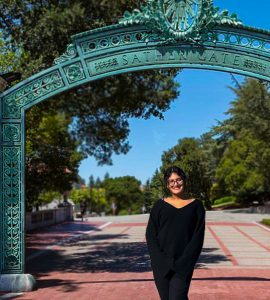
Prathana Adhikari is a graduate of Summit Tamalpais High, and a second-year student at the University of California, Berkeley currently working towards a degree in Public Health.
Richmond Promise staff connected with Prathana to ask about her higher education journey, plans for her post-grad future, and her advocacy for Mental Health discourse in relation to her passion for Public Health.
Q: Tell us a little bit more about who you are:
My name is Prathana Adhikari, my pronouns are she/her. I’m from Richmond and I attended Summit Tamalpais High School. I’m currently a second-year, intended Public Health major at UC Berkeley. Some on-campus communities I’m a part of are Navigating Cal (NAVCAL), the Basic Needs Center, and the Public Service Center. I’m also a Students Online Achieving Results (SOAR) scholar and a Umoja Health Youth Mobilizer.
Q: Of any of the organizations you have been involved with, what projects have you participated in or led?
I started as a NAVCAL fellow in Spring of 2023 and since then I’ve been an intern working to help provide support and guidance to NAVCAL fellows. Through NAVCAL, I learned about Umoja Health and I was part of the Umoja Health Workforce Internship last summer. After the end of the internship, I had the opportunity to continue working with Umoja Health as a Youth Mobilizer where I currently lead the social media team in creating social media content focused on health education and youth engagement. I’m also part of the health campaign team where we’ve created push cards and digital content about different health risks including STIs that are prevalent among youth. As a Youth Mobilizer, I also work with Alameda County to host health education events, conduct risk assessment surveys, and come up with programs to better the lives of youth in Alameda County.
Q: Our RP Scholar Success Manager, Dariana Zermeño, told us you facilitated a workshop for NAVCAL at UC Berkeley. Can you tell us more about what this workshop was about and what the experience was like?
I have now facilitated twice for NAVCAL. The first time, I facilitated with a fellow intern and our focus was on self-care, we covered topics of mental health, shared helpful resources available to fellow UC Berkeley students, and overall demystified and encouraged self-care practices. I facilitated again for a few weeks with my cohort and our focus was Resources. We touched on our experiences with imposter syndrome, talked about our struggles with utilizing and accessing resources, especially as first-generation college students, and we also shared on-campus resources we’ve used and benefited from. As someone who struggles with public speaking, I was hesitant about facilitating since it can be very intimidating having to facilitate a class of 30+ students for an hour and a half but I enjoyed it. Through facilitating, not only did I learn a lot more about the behind-the-scenes prep, but I also was able to connect with more people and it was an opportunity for me to grow and work on these skills that will be essential later on in my career.
Q: You were previously involved with Richmond Promise as a Summer Associate. What was your experience like as a Summer Associate? And how has Richmond Promise made an impact on you?
As a Richmond Promise Summer Associate, I was paired with NAVCAL and helped with their Summer fellowship last summer. Through this, I was able to help other first-generation students, many also from Richmond. Through Richmond Promise’s workshops, I gained practical knowledge and skills that made me feel more confident and prepared as I transitioned into college as a first-generation student. These workshops covered topics like academic planning, financial literacy, and navigating campus resources. I also learned about NAVCAL through Richmond Promise, which broadened my understanding of community resources and support available to students.
Q: Congratulations on obtaining a summer internship with Health Career Connection (HCC)! What type of work will you be accomplishing through HCC this summer?
I learned about HCC through NAVCAL. I will be interning with the RYSE Center in Richmond helping with their Health Justice Department. A lot of my work will be around helping run their health and wellness programs, including helping organize health education classes and developing a curriculum for those classes. I’m looking forward to working in the health education field, enhancing my professional skills, and giving back to my community in Richmond.
Q: What are your plans for the future?
During my time at UC Berkeley, I hope to continue exploring different avenues in health whether it is through classes, clubs, and on-campus jobs/internships. I want to continue making these meaningful connections and to continue with community service. Post undergrad, I will be pursuing a Masters in Public Health with a focus on either Maternal, Child, Health, or Human Nutrition and eventually a DrPH. I see myself continuing to work closely with my communities, to help mitigate health inequity and focusing on health education. My ultimate goal is to be a Public Health Educator and to reach and serve marginalized and underserved communities on a local and global level.
Q: May is Mental Health Awareness Month, how do you see your interests in public health aligning with discussions and awareness for mental health?
A big part of my passion for public health comes from recognizing patterns of health inequity, especially in communities of color. These health inequities result in the spread of misinformation and stigmatization of health. This is especially true when it comes to mental health, which is heavily stigmatized, leading to hesitancy and fear resulting in this negative cycle. To combat these stigmas we need to have more open conversations about mental health so we can reduce misconceptions and encourage people to seek help. Some ways I share awareness surrounding mental health is by being open about my struggles, sharing self-care tips, and advocating for creating safe spaces for discussions on mental health. By normalizing these conversations and promoting understanding, we can break down barriers and empower individuals to prioritize their mental well-being.
Photo Courtesy of Prathana Adhikari
Author’s Note: For more student-centered Mental Health resources and hotlines, check out the RP May Scholar Newsletter.