

Taking Advantage of Opportunities
Studying at UCLA provided RP alum Arnold Dimas with a pathway to a career in public health

APROVECHA.
Arnold Dimas remembers his parents’ advice in Spanish, instilled at an early age, that loosely translated served as encouragement to take advantage of opportunities that would come his way.
“I always try to be resourceful,” Dimas said. “Who can I talk to, who can I connect with? What can I learn? Is there anything (for which) I can be of service? That’s kind of been the trajectory that I’ve tried to build for myself.”
Now a few years removed from attending college at UCLA, Dimas works as a Planner responsible for grants management and grant writing at La Clinica de La Raza in Oakland. La Clinica provides “culturally appropriate high quality, accessible health care for all,” for patients spanning Alameda, Contra Costa and Solano counties.
In his role, he stewards grants that support eight sites across three Bay Area counties, leads and executes grant proposals and budgets, and has worked to restructure internal processes that have increased programmatic and fiscal efficiency.
Working at La Clinica is the present, but it’s the opportunities along the way that have helped shape his professional direction.
Dimas graduated from Richmond High School in 2016 with his sights set on moving to Los Angeles. Having been accepted to UCLA, he applied for multiple scholarships and received several, one being the Gates Millennium Scholarship.
He also became one of the first Richmond residents to receive a Richmond Promise scholarship. Each piece of the puzzle added up, and helped him pay for books, food and other essentials in addition to tuition.
“I remember thinking ‘go for as many (scholarships) as you can’,” Dimas said of his plan to help finance his college journey. “Then, whatever you get, you just hold on to that and figure it out from there.
“Those little things go such a long way.”
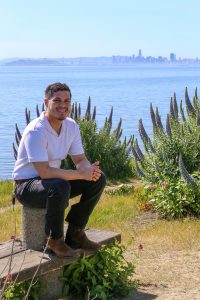 Learning to navigate a university the size of UCLA took some adjusting, and the challenges of independent life became more present. Eventually, two programs provided Dimas with a path forward, and turned out to be two of the defining experiences of his time as an undergraduate.
The first took a bit of persistence. Following his sophomore year, he applied to the UCLA Public Health Scholars Training Program, a summer program funded by the Centers for Disease Control & Prevention (CDC) Office of Minority Health & Health Equity. He didn’t get accepted right away, but he kept after it, and earned a spot the following year.
“Here, you’re basically part of a cohort of about 40 people, with everyone’s interest in and exposure to public health varying across a broad spectrum,” Dimas said. “Some were set on public health. Some people had a piquing interest or were recently introduced to it. And others wanted to pursue fields like medicine, social work, education, and others, but were still curious about how they related to public health also. So we had a diverse mix of cohort members with different interests, backgrounds, lived experiences, and even different ages too, as the program welcomed not only undergrads, but recent graduates, and non-traditional students as well.”
As part of the program, Dimas also got connected with a graduate student mentor, a professional mentor and an academic mentor. The networking and social immersion of living with his cohort helped him create his own place on campus, marking a pivotal turning point in his growth — not only academically and professionally, but also personally.
Dimas’ second foundational experience came shortly after the first. Through UC Davis, he participated in the Latinx Health Internship Program that took him to Oaxaca, Mexico. As part of the program, he traveled to hospitals and community health centers, which provided a first-hand look at many of the public health elements he was studying.
He could see a journey into the field of public health taking shape. But, what the trip to Oaxaca did more than anything else was reinforce just how broad and far-reaching the possibilities of the discipline actually were.
“I remember feeling like there was a bit of a discrepancy in putting together various kinds of public health topics,” he said. “It’s like, you want to study this one topic — but it’s only restricted to that. And then you want to connect it to something else, but it’s also siloed off. And in this program, we put so many of those different topics into conversation with one another. One day, we’d be discussing mental health and relating it to migration and intergenerational trauma. Then another, we’d be discussing substance use, domestic violence, and machismo. Then, we’d talk about nutrition, obesity and chronic disease. And throughout it all, we’d put so many different topics in conversation with each other, always finding a way to relate ideas and make new connections.
“And, I think the professor was also amazing. She played a really important role in kind of helping us see ourselves and our families in the topics that we discussed in class. So, in a way, it was almost as if our sessions were a collective healing experience — like they were healing circles. There were some days, I remember, where we’d end the day and look around the room to find each other with tears in our eyes, and it was like, wow, that was very profound.”
He went on to earn his Bachelor’s in Anthropology, and added minors in Global Health and Chicano Studies along the way. But, by the time he was ready to wrap all that up, one particular public health topic moved front and center across the world.
As Dimas worked on his final quarters at UCLA, the COVID-19 pandemic changed life for everyone. He finished his undergraduate career remotely from Richmond, got a job working as a remote Bilingual Resource Coordinator Lead for the Public Health Institute in Oakland, and turned his attention towards graduate school.
In the fall of 2021, he returned to UCLA to work toward a Master of Public Health degree. Move-in weekend coincided with the delayed graduation ceremonies UCLA had worked to provide for students who graduated during the pandemic, and his family turned it into a road trip that let them celebrate the accomplishment together.
As he moved through his graduate studies, Dimas became interested in the work that happens behind the scenes for the programs he was studying. As he worked with a specific program, he’d wonder where it got its funding. Sometimes, he’d wonder why a program was created in the way it was and how they measured success when it came to the mission or goals they set for themselves.
In the fall of 2023, Dimas moved back to Richmond with his Master’s complete and landed his current role at La Clinica. By working with grants, he’s been able to shift focus to the behind the scenes work that fuels community-based organizations.
At the same time, he returned to his roots.
“Richmond is home for me,” he said, “but for deeper reasons. For example, growing up, my family and I would attend church on Sundays at Saint Cornelius. And to this day, we still do. While I could go to any parish somewhere else, going here is a core part of what makes this place feel like home.”
Dimas sees the value in a program like Richmond Promise, and it’s clear that his personal journey to and through college has played a big role in shaping both the present as well as any future opportunities he might choose to pursue.
So, what advice would he give to Richmond Promise Scholars going through their own postsecondary journeys?
“I would say have a vision for yourself and what it is that you want or hope to accomplish. I’d say to constantly revisit that and make sure that your goals remain aligned with you as you evolve and grow over time.
“I would also say to be resourceful. Find mentors and guides, especially people doing things that you’d like to do one day. Maybe in different fields or specific roles, etc. Always be humble, but know your worth and also just have fun along the way. Sometimes you get to look back and realize how beautiful an opportunity it was to have been in school, even with its challenges.”
In other words…
Aprovecha.
Throughout 2026, Richmond Promise is celebrating its 10th year of serving Richmond students by sharing the stories of RP alumni now making an impact as part of the local workforce. To support the next generation of Richmond Promise Scholars, please visit the Give page. To suggest a Richmond Promise alum to be featured, email benos@richmondpromise.org.